


- PRODUCTSFREEWAREFOR COMMERCIAL USEFOR PERSONAL AND BUSINESS USEBackup and System Restore:PC Privacy and Security:
- BUY ONLINE
- DISTRIBUTION
-
Emergency File Recovery Using R-Studio Emergency


Many computer users have had the unfortunate experience at least once (and perhaps twice, or, with really bad luck, even more) of discovering that their computer no longer starts. The computer"s hardware seems to be functioning, and the operating system can be restored from a system recovery disk. But those scary messages tell the user that such a system recovery will destroy all the data — family photos, movie and music collections, and valuable financial docs could be lost for good.
Well, that could happen, but it won't, thanks to a special procedure called an " emergency file recovery," in which the computer is started from a special startup disk containing a file recovery tool.
R-Studio Emergency is an excellent choice for tackling this procedure under these circumstances. So let's see how R-Studio Emergency could save your endangered files.
To give you step-by-step instructions on how to perform emergency file recovery using R-Studio Emergency, we'll use two cases.
1. A Windows 11 computer cannot start due to OS failure. The system disk has a BitLocker-encrypted file system, in relatively good conditions, but the file system on the second disk is damaged beyond recognition. We need to copy the user's files from the system disk and recover files from the second one. R-Studio Emergency Standalone will be used for this case, and recovered files will be saved to an external USB drive.
2. A Linux computer cannot start due to an OS failure. We need to copy the user's files from a relatively valid file system. R-Studio Emergency Technician will be used for this case and recovered files will be saved to a network drive.
Common preparations for both cases.
Hard Drive Inspection
The goal of inspecting hard drives is to ensure they don't have any hardware issues. Symptoms that a hard drive has hardware problems:
- Your system does not recognize the device anymore, or it appears under an unusual name.
- The hard drive makes unusual noises, clicks, and starts too slowly.
- Bad blocks constantly appear on your hard drive.
- SMART inspecting programs report a severe hardware failure event.
Important! If you believe that the hard drive in the computer is malfunctioning, use R-Studio Emergency to create an image of the entire hard drive. DO NOT DO ANYTHING ELSE WITH IT BY YOURSELF ANYMORE! Don't try to run a scan or recovery procedure. Don't try to use some other data recovery software. Remember, tampering with a drive in this condition will surely inflict more damage to your files. At best, you'll have to pay extra money to a professional data recovery service. At worst, you'll lose all your data for good. Bring the drive to qualified data recovery professionals. They have special equipment, software, and, most important, the required skills to work with such drives.
Moreover, it is a good practice to always create images and recover files from them, even if the hard drive and other hardware work normally. This keeps your data safe from accidental data corruption.
If there are no problems detected, we can go further to actual file recovery.
A place to store recovered files and other information, like scan info and disk images. We will use:
- For the first case: an NTFS-formatted USB drive. It can be a flash stick if its size is sufficient to store all recovered files, or an external USB HDD/SSD device if a large storage space is required.
- For the second case: a network computer with an accessible network share. Below, we'll explain how to connect this share as a network drive in R-Studio Emergency.
And always remember the most important rule: NEVER TRY TO SAVE RECOVERED FILES/FOLDERS ON THE SAME LOGICAL DISK WHERE THEY RESIDE!!! Or you may obtain unpredictable results and lose all your data.
Creating R-Studio Emergency Startup Disks
The process of creating R-Studio Emergency Startup devices is described in R-Studio online help:
R-Studio Emergency > Creating Startup Disks.
R-Studio Emergency has all the functionality of R-Studio. Almost all its controls are similar to those of R-Studio itself. So you can always consult the R-Studio online help when a question arises.
Actual File Recovery
Case 1: File recovery from a Windows 11 computer that cannot start
We'll use a Windows PE-based Standalone R-Studio Emergency Startup version installed on a USB stick and an external USB storage device for recovered files.
The main advantage of the WindowsPE-based version is that it supports Secure Boot, which minimizes interference with system BIOS settings.
Starting Your Computer Using R-Studio Emergency Startup Device
Make the device with R-Studio Emergency bootable in your computer's BIOS. Refer to the computer's documentation for details. Then start your computer.
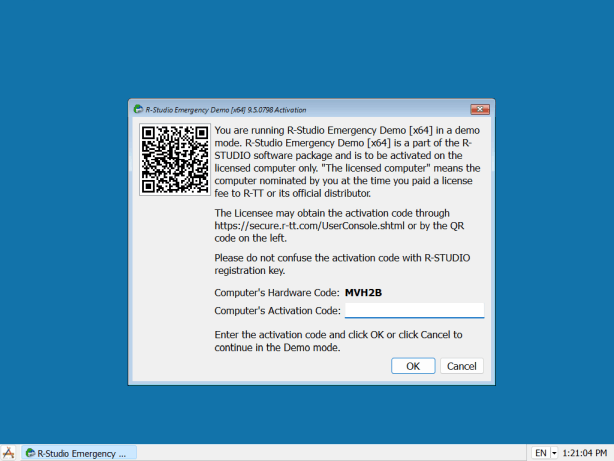
The first screen you see when R-Studio Emergency starts is the R-Studio Emergency Demo Activation dialog box.
Click image to enlarge
Use your smartphone to scan the QR code to obtain the activation code, or click the Cancel button to use R-Studio Emergency in Demo mode to evaluate your chances of successfully recovering your files.
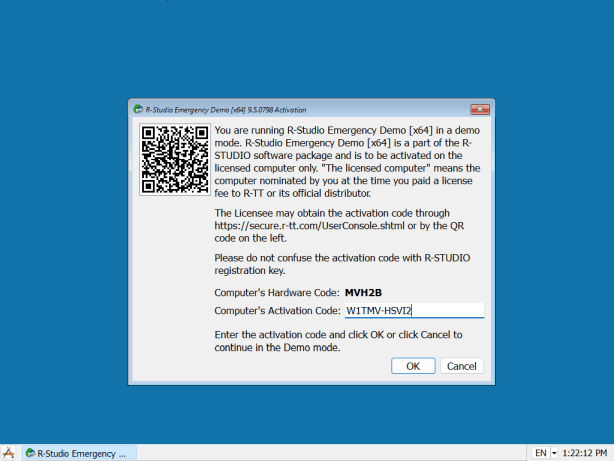
1. Enter the activation code and click the OK button.
Click image to enlarge
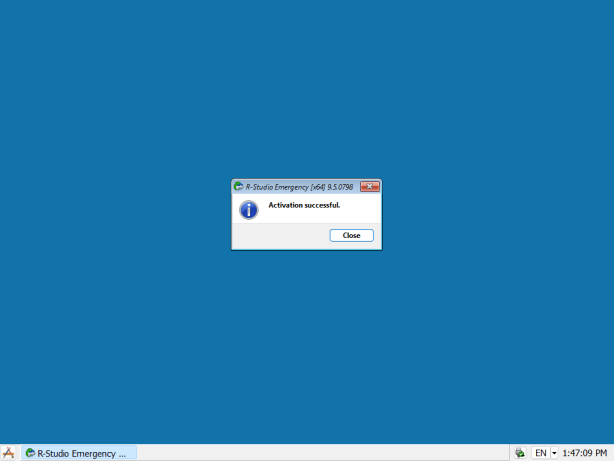
> The Activation successful message will appear
Click image to enlarge
2. Click the Close button, and the R-Studio's Main panel will appear.
Inspecting the Damaged Computer
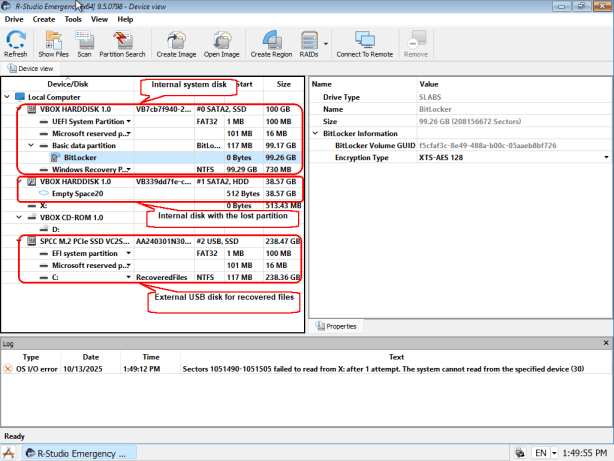
Looking at the panel, you may see the computer's hardware and estimate which data on the hard drive is damaged.
Click image to enlarge
There are two internal hard drives: one with a valid, BitLocker-encrypted file system, and the other is a lost partition shown as the Empty Space20 object.
If you plan to use a network drive to save recovered files and other information, it's time to set up a network connection and connect a network drive. Go to the Network Setup section for more information.
File Recovery
For our first case, we need to perform two data recovery tasks:
- Copy existing files from the system disk with an intact file system encrypted with BitLocker.
- Recover files from a lost logical disk.
Copying files from the BitLocker-encrypted system disk
We start with recovering files from the encrypted system disk.
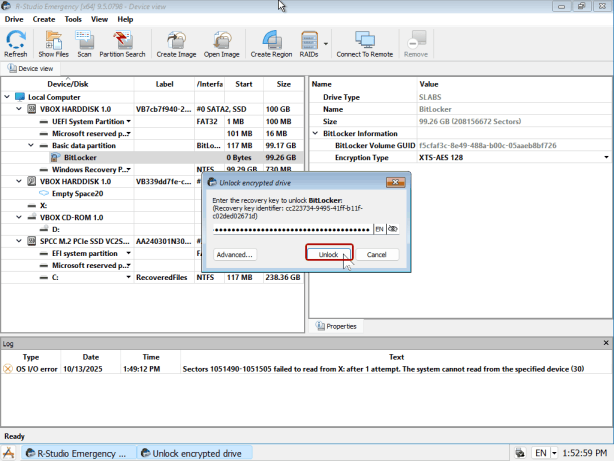
1. Double-click the BitLocker container and enter the proper recovery key.
Click image to enlarge
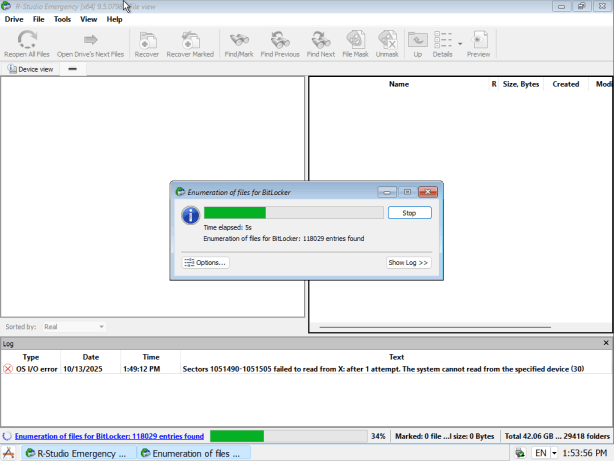
> R-Studio will enumerate the files
Click image to enlarge
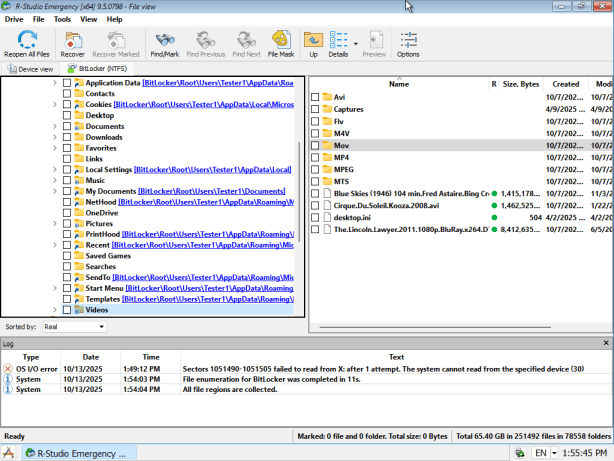
and show the folder/file structure on this partition.
Click image to enlarge
2. You may sort files by their types (extensions), times (Creation, Modification, Access) and search for individual or groups of, files when necessary.
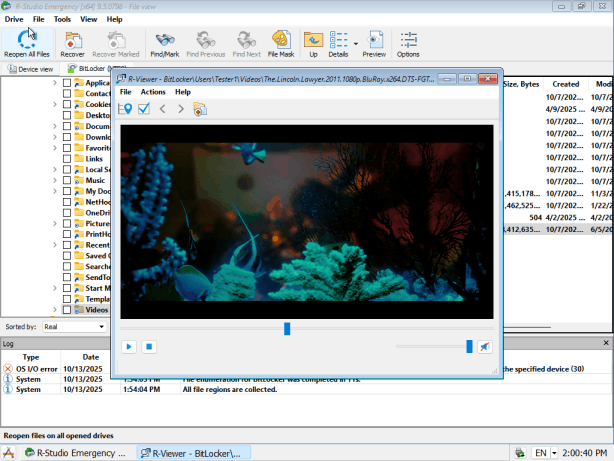
3. You may estimate the chances of recovering files using the powerful built-in previewer. You may do it either by double-clicking the selected file, whether it's a deleted or existing one,
Click image to enlarge
or by switching to icon view.
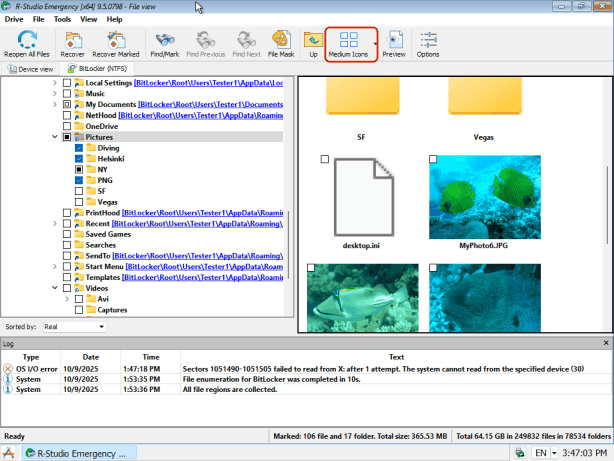
Click image to enlarge
4. If you've found all the files you want and they are satisfied with their previews, mark them for recovery,
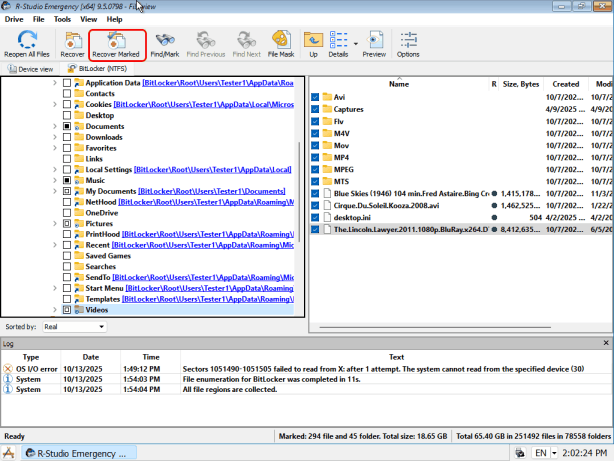
Click image to enlarge
then click the Recovery Marked button.
> The Recover dialog box will appear
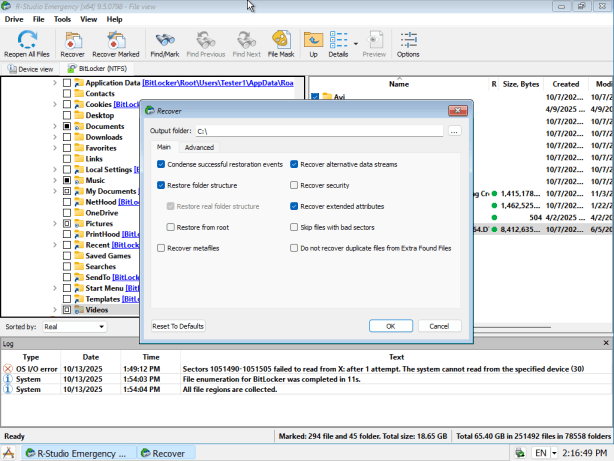
Click image to enlarge
5. Specify the Recovery options, then click the OK button.
You may find more information on these options in the R-Studio online help: Basic File Recovery.
> R-Studio will start recovering files and display its progress.
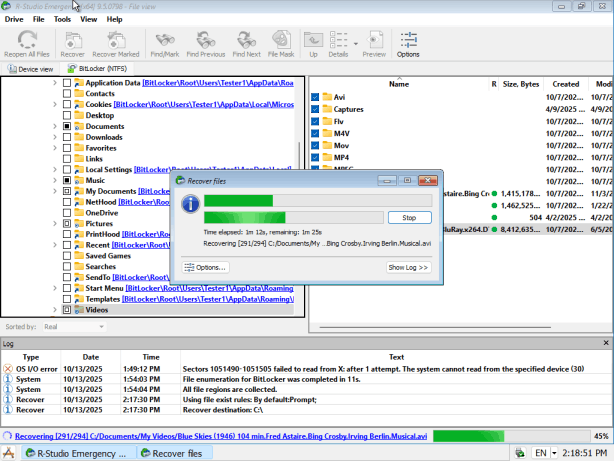
Click image to enlarge
> When this process is over, R-Studio will show its results.
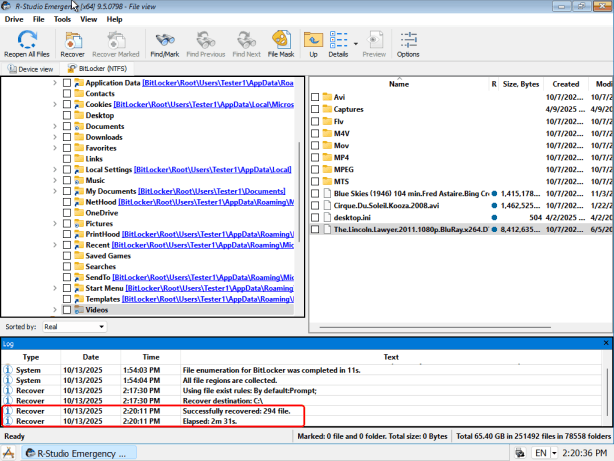
Click image to enlarge
File Recovery from the lost logical disk
Now we'll continue file recovery and recover files from the lost logical disk on the Empty Space20 object.
First, you need to run R-Studio to scan the object and determine which information remains on the disk. When the scan is finished, R-Studio will display one or more recognized partitions, so you can choose the correct one and recover files from it, as described in the Copying files from the BitLocker-encrypted system disk section. Sometimes there may be no such information, and R-Studio will have to rely only on the found raw files (Scan for Known File Types).
1. Select the Empty Space 20 object and click the Scan button.
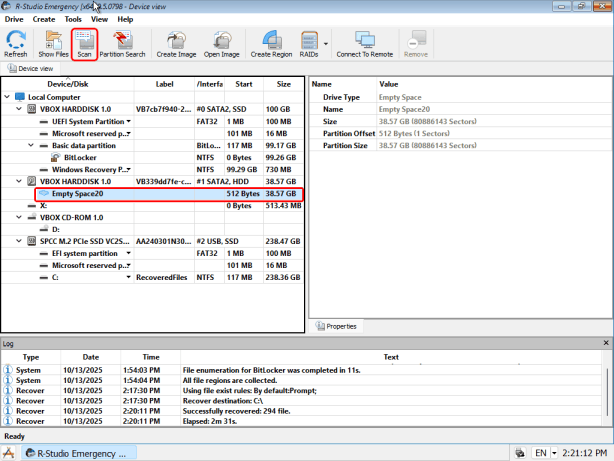
Click image to enlarge
> The Scan dialog box will appear.
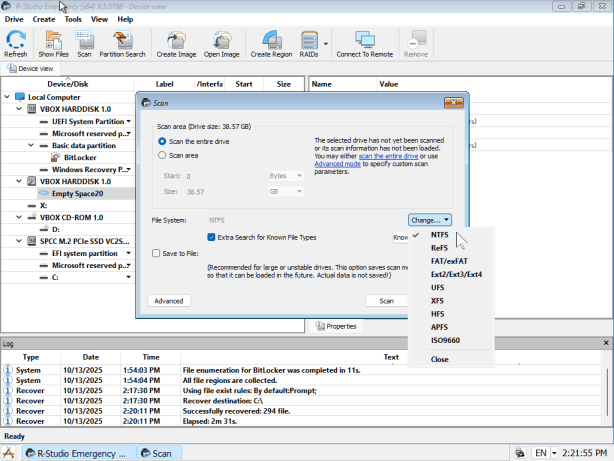
Click image to enlarge
2. Leave selected only the necessary file system, specify other parameters, and click the Scan button. You may read more about the scan parameters in the R-Studio online help > Drive Scan.
> R-Studio will start scanning the object and display its progress.
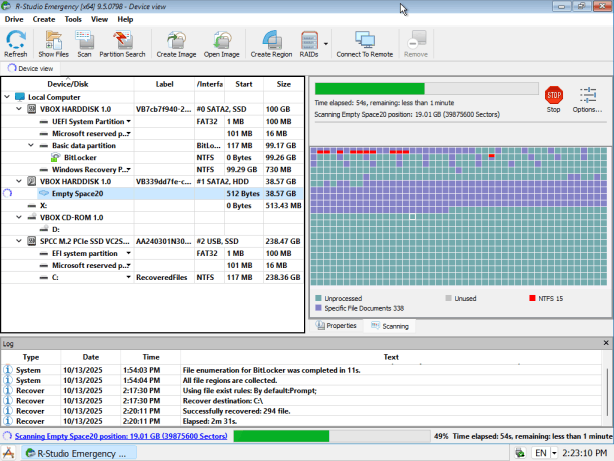
Click image to enlarge
Only Raw Files have been discovered after this scan.
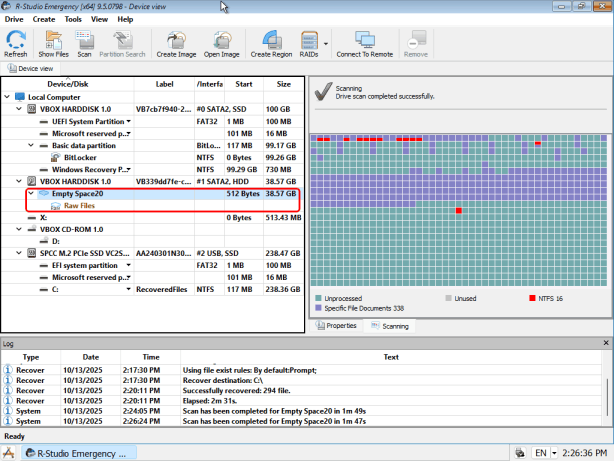
Click image to enlarge
3. Double-click Raw Files, inspect the found files, and preview them if necessary.
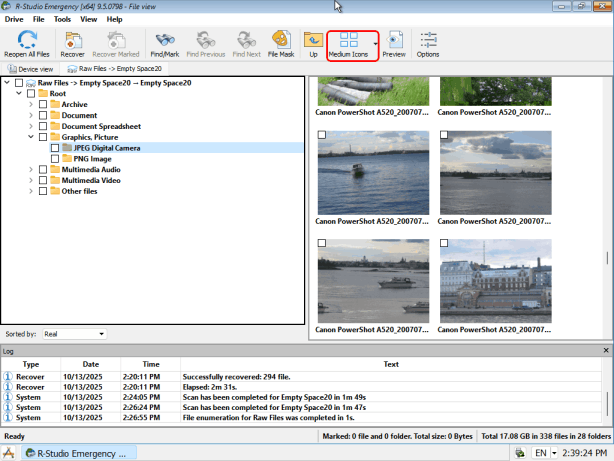
Click image to enlarge
4. Mark the files for recovery, then click the Recovery Marked button.
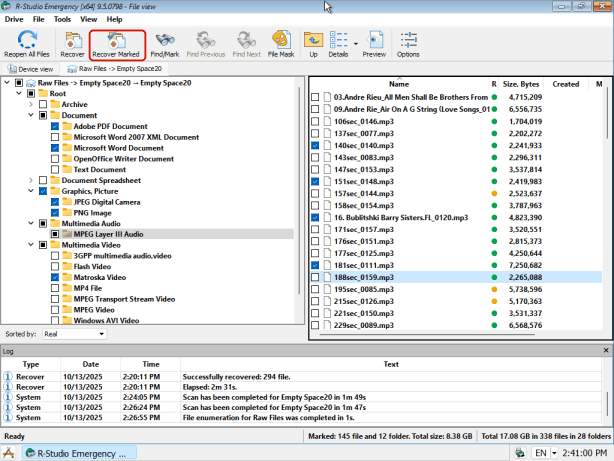
Click image to enlarge
> The Recover dialog will appear.
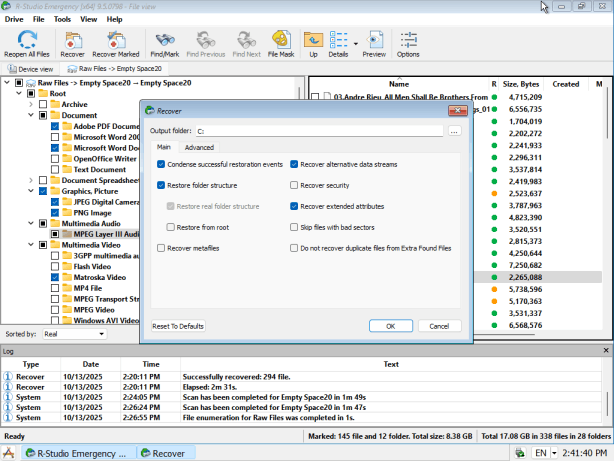
Click image to enlarge
5. Specify recovery parameters and click the OK button.
You may find more information on these options in the R-Studio online help: Basic File Recovery.
> R-Studio will start file recovery and display its progress.
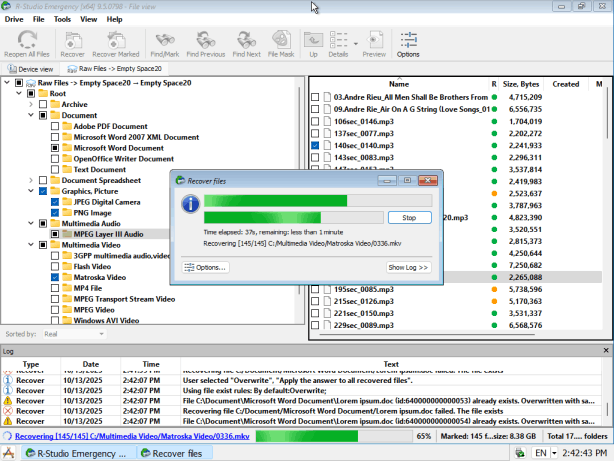
Click image to enlarge
> When this process is over, R-Studio will show its results.
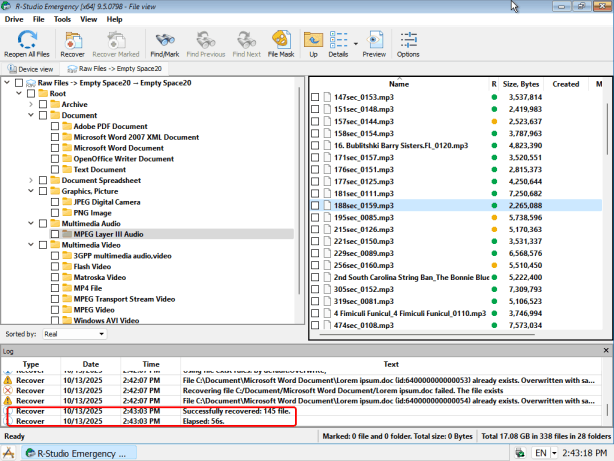
Click image to enlarge
Computer Shutdown
When you finish file recovery, remove the USB disk and turn your computer off manually.
Case 2: File recovery from a Linux computer that cannot start
R-Studio Technician can create a special USB activation stick that can be used not only to verify the license, but also to add R-Studio Technician Portable and one of the bootable R-Studio Technician Emergency (Startup version) versions (based on WinPE or Linux). It means that a technician version licensee can create a universal USB stick and use it to run R-Studio Technician on any computer online or offline, running OS or with a damaged OS, at a facility with or without Internet access.
We'll use a Linux-based Technician R-Studio Emergency Startup version installed on a USB stick and a network drive for recovered files.
Starting Your Computer Using R-Studio Emergency Startup Device
Make the device with R-Studio Emergency bootable in your computer's BIOS. Refer to the computer's documentation for details. Then start your computer.
1. Start your computer. The Startup Options screen will appear.
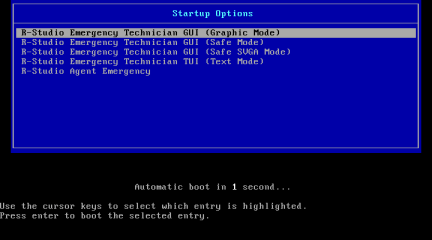
Click image to enlarge
2. Select R-Studio Emergency GUI (Graphic Mode) to start R-Studio Emergency in its graphic mode. In this mode, R-Studio Emergency has all the functionality of R-Studio itself. Almost all the controls in this version are similar to those in R-Studio itself. So you can always consult the R-Studio online help when a question arises.
Select R-Studio Emergency GUI TUI (Text Mode) if you experience a problem with the graphic system. In this mode, R-Studio still has a graphical interface, but it is rendered using text characters and uses standard graphics modes supported by all graphics systems. The functionality of this mode is a bit more limited than that of the Graphic Mode, but you still can perform most data recovery operations, and it supports a mouse. However, previewing graphic files is impossible. You may find more information on how to work with R-Studio Emergency in its Text Mode in the R-Studio online help > R-Studio Emergency Operation.
Inspecting the Computer
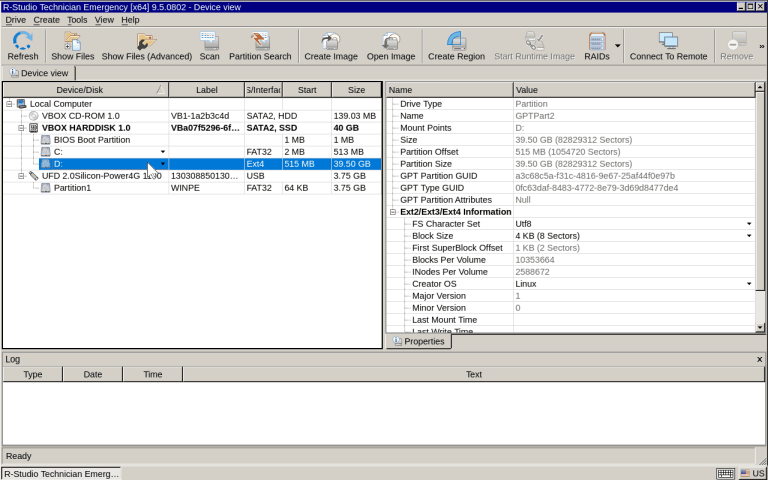
When R-Studio starts, its Main panel appears. Looking at it, you may see the computer's hardware and estimate which data on the hard drive is damaged.
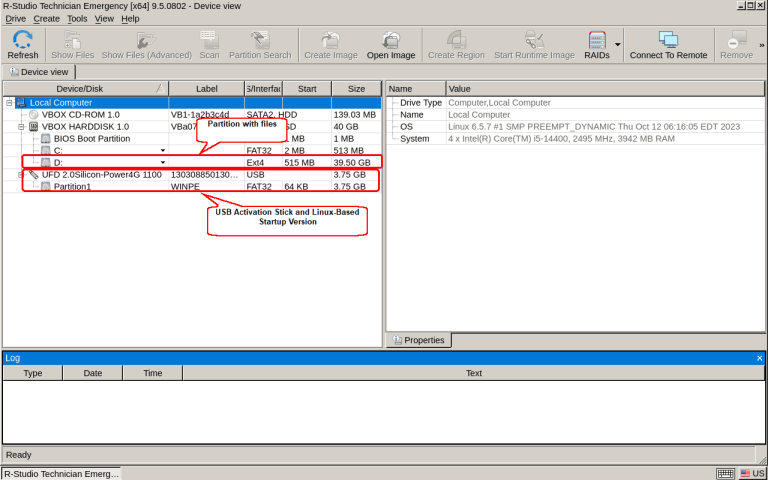
Click image to enlarge
Network Setup You may use both DHCP and manual configuration to obtain an IP address for the computer running R-Studio Emergency.
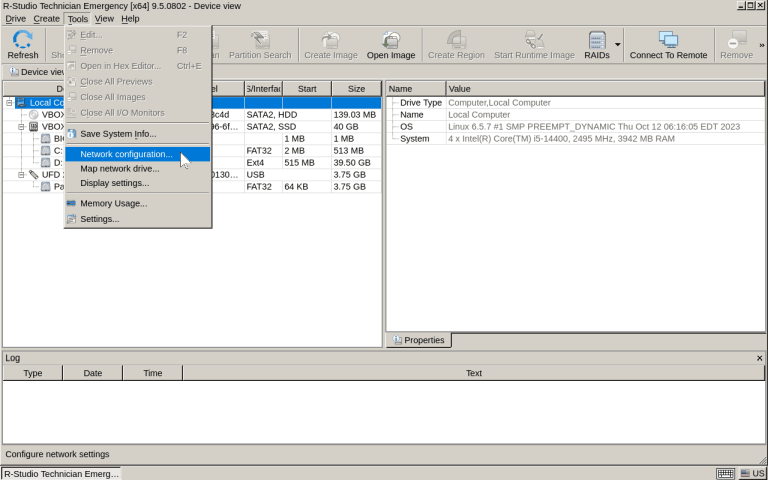
1. To start network configuration, select Network configuration in the Tools menu.
Click image to enlarge
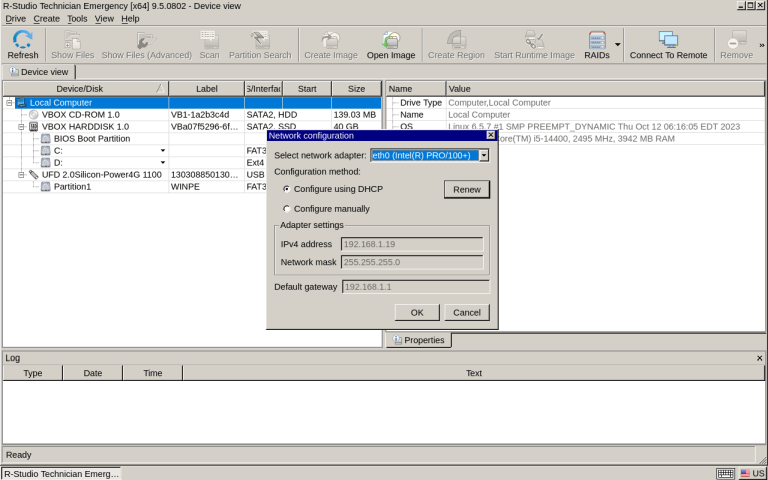
> The Network configuration dialog box will appear, and R-Studio will automatically start acquiring a network address using DHCP. The Log panel will show the Network adapter configuration started message.
Click image to enlarge
You may cancel this process by selecting Configure manually. Then you need to enter the address manually. If your computer has several network interfaces, you may select which interface is to use.
Once the network address is obtained, it appears in the dialog box.
If R-Studio fails to obtain the address, the log will show the Network adapter configuration failed message. In that case, you have to either enter the address manually or resolve any network issues.
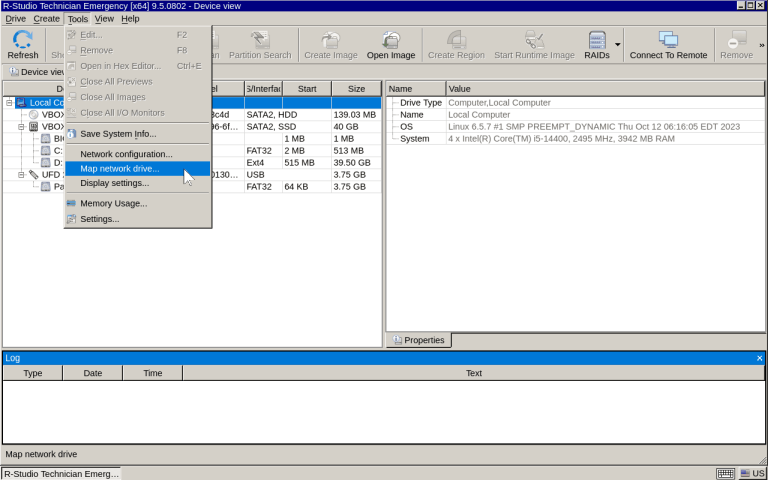
2. Then specify a network share where the data will be saved. Select Map network drive on the Tools menu.
Click image to enlarge
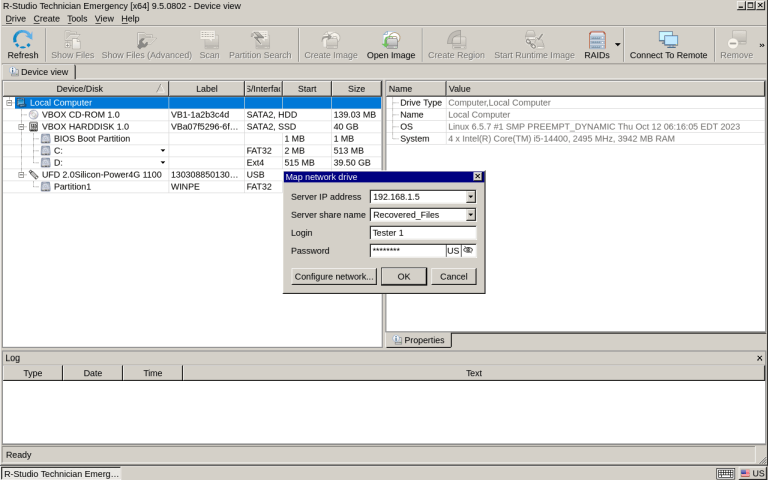
> The Map network drive dialog box will appear.
Click image to enlarge
3. Enter the necessary data, and click OK.
4. Double-click the partition with files to enumerate them.
Click image to enlarge
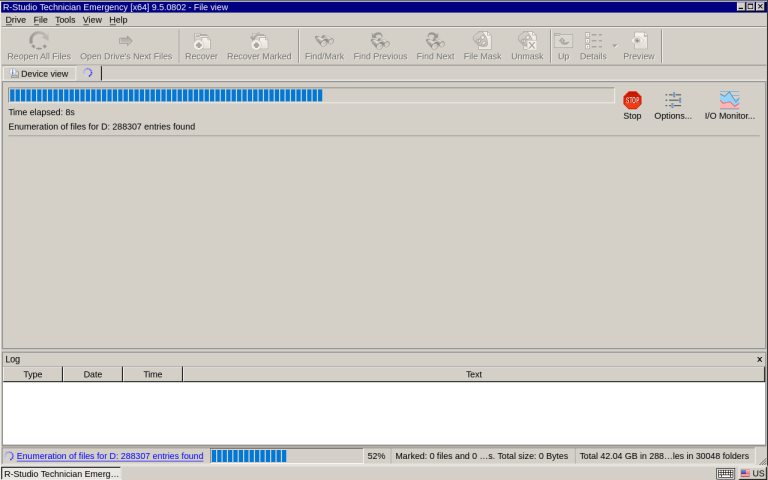
> R-Studio will enumerate the files, showing its progress
Click image to enlarge
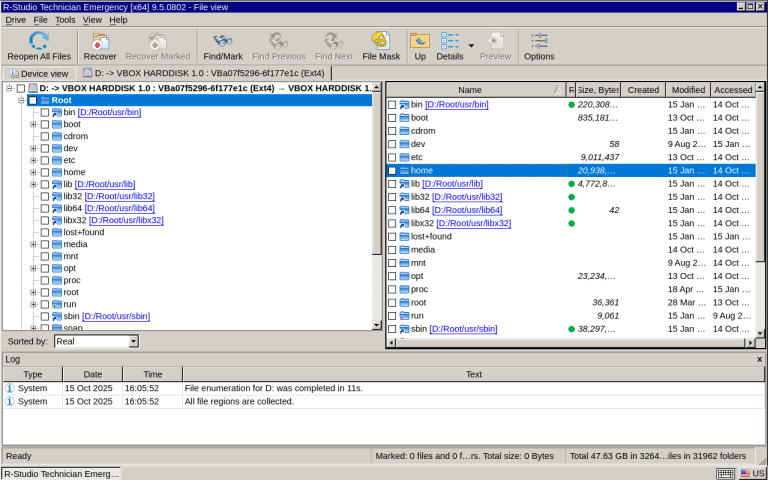
and the folder/file structure on this partition.
Click image to enlarge
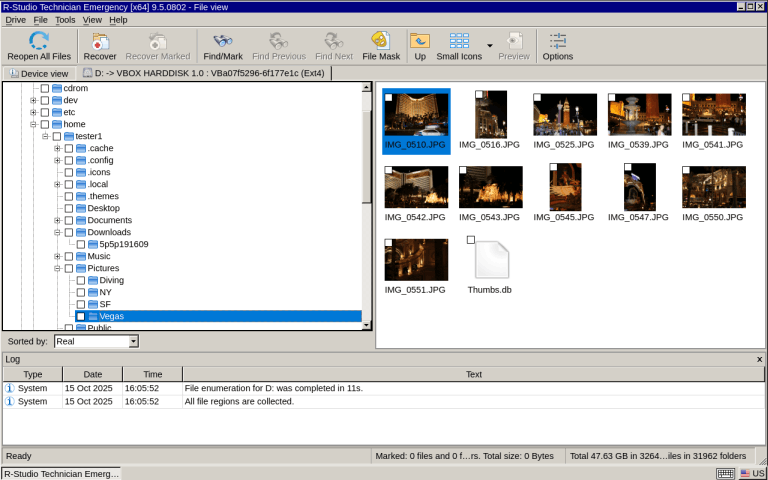
5. You may sort files by type (extension), time (Creation, Modification, Access), and search for individual or groups of files when necessary.
You may do it either by switching to an icon view
Click image to enlarge
or by double-clicking the selected file, whether it's a deleted or existing one.
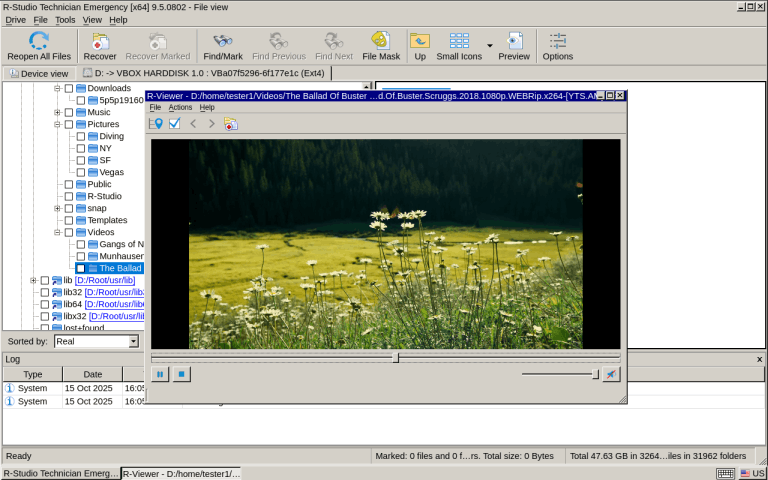
Click image to enlarge
6. Mark files for recovery and click the Recovery Marked button.
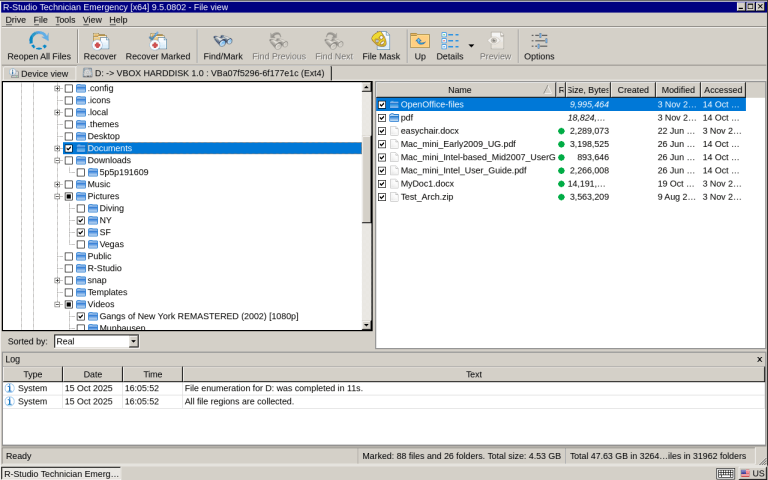
Click image to enlarge
7. Specify the Recovery options,
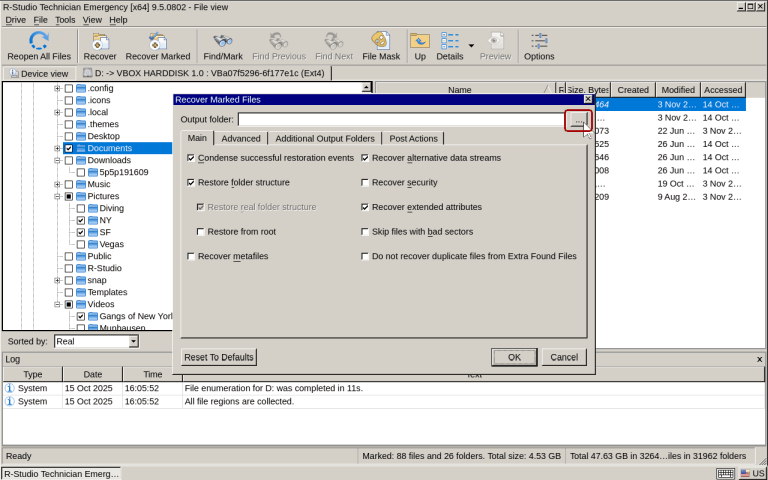
Click image to enlarge
and select the network drive as the location to store recovered files.
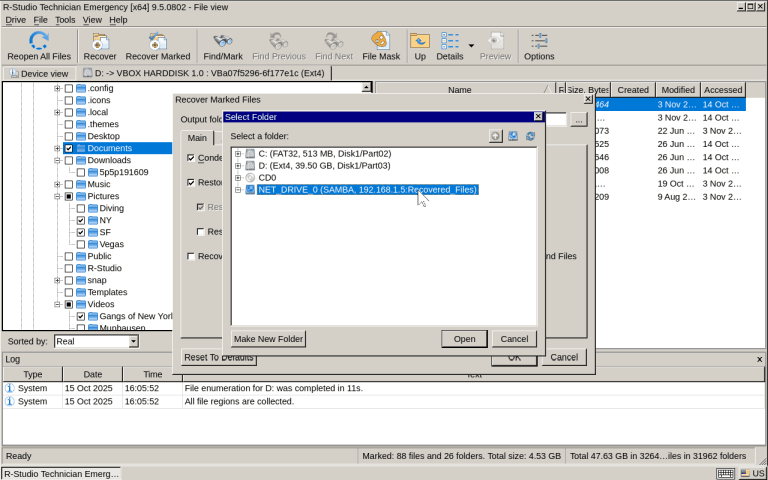
Click image to enlarge
You may find more information on these options in the R-Studio online help: Basic File Recovery.
8. Click the OK button.
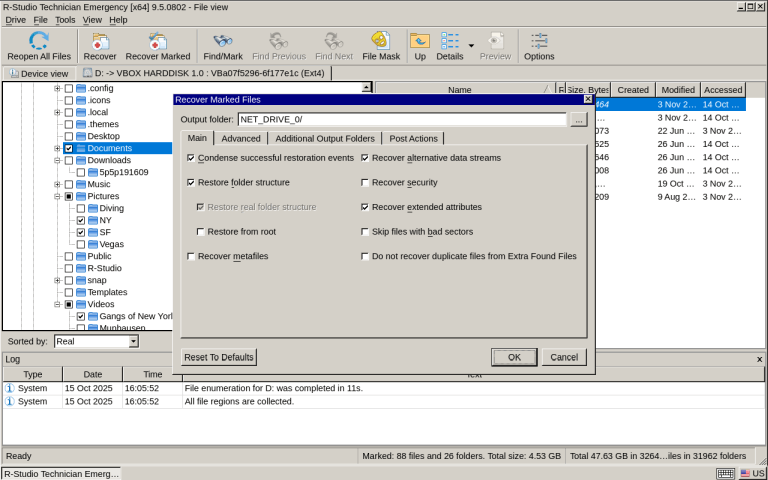
Click image to enlarge
> R-Studio will start recovering files and display its progress.
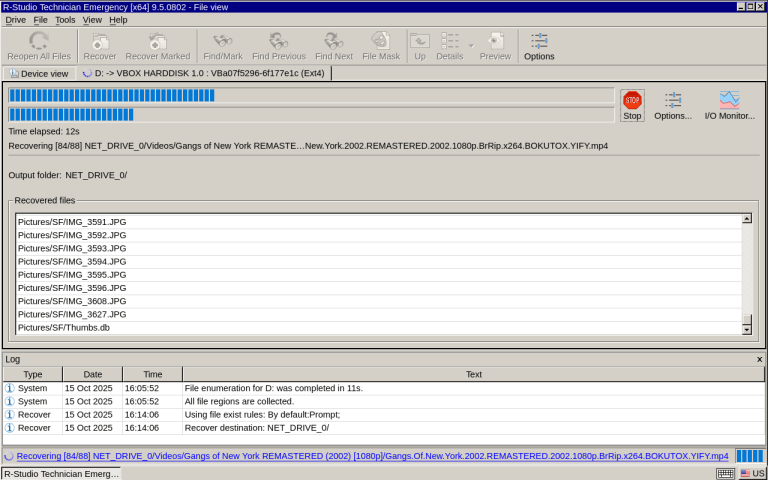
Click image to enlarge
When this process is over, R-Studio will show its results.
Click image to enlarge
Computer Shutdown
When you finish file recovery, remove the USB disk and turn your computer off manually.
- R-Studio Technician: activation using a USB stick
- Data Recovery Guide
- Why R-Studio?
- R-Studio for Forensic and Data Recovery Business
- R-STUDIO Review on TopTenReviews
- File Recovery Specifics for SSD devices
- How to recover data from NVMe devices
- Predicting Success of Common Data Recovery Cases
- Recovery of Overwritten Data
- Emergency File Recovery Using R-Studio Emergency
- RAID Recovery Presentation
- R-Studio: Data recovery from a non-functional computer
- File Recovery from a Computer that Won't Boot
- Clone Disks Before File Recovery
- HD Video Recovery from SD cards
- File Recovery from an Unbootable Mac Computer
- The best way to recover files from a Mac system disk
- Data Recovery from an Encrypted Linux Disk after a System Crash
- Data Recovery from Apple Disk Images (.DMG files)
- File Recovery after Re-installing Windows
- R-Studio: Data Recovery over Network
- How To Use R-Studio Corporate Package
- Data Recovery from a Re-Formatted NTFS Disk
- Data Recovery from an ReFS disk
- Data Recovery from a Re-Formatted exFAT/FAT Disk
- Data Recovery from an Erased HFS Disk
- Data Recovery from an Erased APFS Disk
- Data Recovery from a Re-Formatted Ext2/3/4FS Disk
- Data Recovery from an XFS Disk
- Data Recovery from a Simple NAS
- How to connect virtual RAID and LVM/LDM volumes to the operating system
- Specifics of File Recovery After a Quick Format
- Data Recovery After Partition Manager Crash
- File Recovery vs. File Repair
- Data Recovery from Virtual Machines
- How to Recover Files from a Remote Computer Using R-Studio Standalone License and Its Network Capabilities in Demo Mode
- How to Connect Disks to a Computer
- Emergency Data Recovery over Network
- Data Recovery over the Internet
- Creating a Custom Known File Type for R-Studio
- Finding RAID parameters
- Recovering Partitions on a Damaged Disk
- NAT and Firewall Traversal for Remote Data Recovery
- Data Recovery from an External Disk with a Damaged File System
- File Recovery Basics
- Default Parameters of Software Stripe Sets (RAID 0) in Mac OS X
- Data Recovery from Virtual Hard Disk (VHD/VHDX) Files
- Data Recovery from Various File Container Formats and Encrypted Disks
- Automatic RAID Parameter Detection
- IntelligentScan Data Recovery Technology
- Multi-pass imaging in R-Studio
- Runtime Imaging in R-Studio
- Linear Imaging vs Runtime Imaging vs Multi-Pass Imaging
- USB Stabilizer Tech for unstable USB devices
- Joint work of R-Studio and PC-3000 UDMA hardware
- Joint work of R-Studio and HDDSuperClone
- R-Studio T80+ - A Professional Data Recovery and Forensic Solution for Small Business and Individuals Just for 1 USD/day
- Backup Articles
- R-Drive Image Standalone and Corporate license transferring
- Fixing Windows update error 0x80070643 with R-Drive Image
- Backup with Confidence
- R-Drive Image as a free powerful partition manager
- Computer Recovery and System Restore
- Disk Cloning and Mass System Deployment
- Accessing Individual Files or Folders on a Backed Up Disk Image
- R-Drive Image startup / bootable version
- File Backup for Personal Computers and Laptops of Home and Self-Employed Users
- Creating a Data Consistent, Space Efficient Data Backup Plan for a Small Business Server
- How to Move the Already Installed Windows from an Old HDD to a New SSD Device and Create a Hybrid Data Storage System
- How to Move an Installed Windows to a Larger Disk
- How to Move a BitLocker-Encrypted System Disk to a New Storage Device
- How to backup and restore disks on Linux and Mac computers using R-Drive Image
- R-Drive Image and Virtual Machines
- Undelete Articles
- Get Deleted Files Back
- Free Recovery from SD and Memory cards
- R-Undelete: Video Recovery
- Recovery from an External Device with a Damaged File System
- File recovery from a non-functional computer
- Free File Recovery from an Android Phone Memory Card
- Free Photo and Video File Recovery Tutorial
- Easy file recovery in three steps
Rating: 4.8 / 5
R-TT may not be the easiest or most user-friendly solution, but the algorithm used for the renaming saved me THOUSAND of hours of opening ...