
- PRODUCTSFREEWAREFOR COMMERCIAL USEFOR PERSONAL AND BUSINESS USEBackup and System Restore:PC Privacy and Security:
- BUY ONLINE
- DISTRIBUTION
-
Installation, Activation, and Uninstallation instructions for R-Studio Linux Standalone and Corporate licenses


- R-Studio licenses for Linux, Windows, and Mac are separate products in our webstore, and their licenses are not interchangeable. The following instructions are for R-STUDIO (for Linux) Standalone and Corporate licenses. For instructions on the technician versions, please visit the R-Studio Technician and T80+ pages.
- R-Studio Standalone and Corporate licenses are assigned per machine, not per user. Once the software is installed, registered and activated on a machine, it is permanently tied to that machine and cannot be transferred. For more details, please refer to the End User License Agreement.
- If you have purchased an incorrect license or have any concerns regarding the software's functionality or licensing terms, it is imperative that you contact us before activating the license on your intended computer.
- You can download the software setup files from the download page or from our "My Order" portal.
Installation (the Debian package)
You need an Internet connection to register and automatically activate R-Studio Standalone, Corporation, and T80+. If you don’t have one, you’ll need to complete activation manually.
1. Open the downloaded RStudio_x64.deb file with App Center.
2. Ignore the App Center warning and click the Install button.
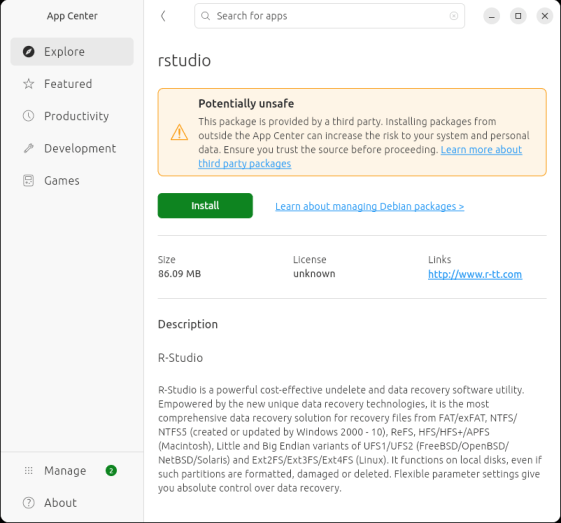
Click image to enlarge
3. Ignore this scary message and click Install,
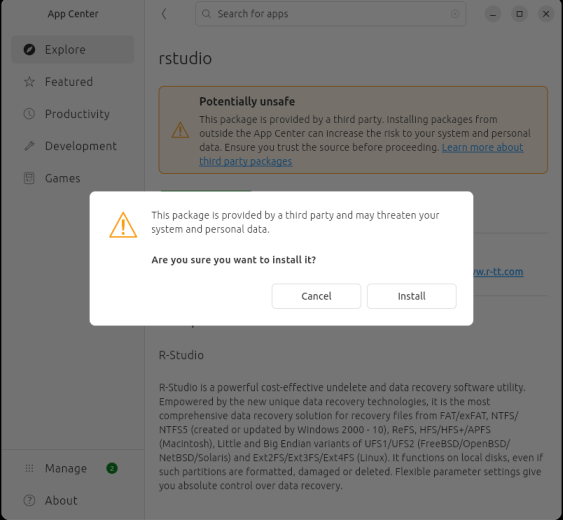
Click image to enlarge
and wait for the installation process to finish.
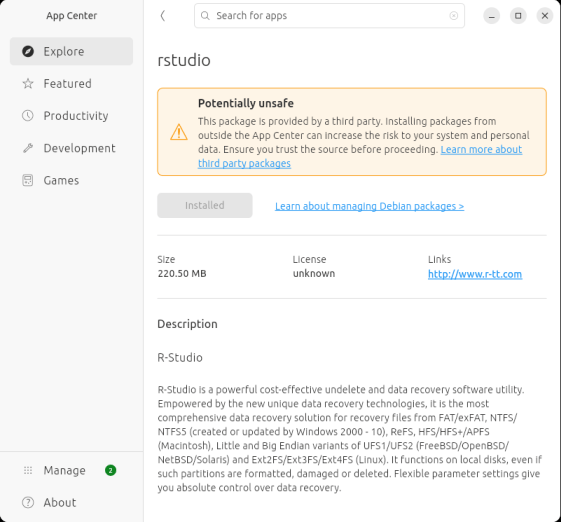
Click image to enlarge
Installation (with the FIPS mode on – the rpm package)
Open Terminal in the folder where RStudio_x64.rpm resides and type sudo "rpm -ivh RStudio_x64.rpm - -nodigest".
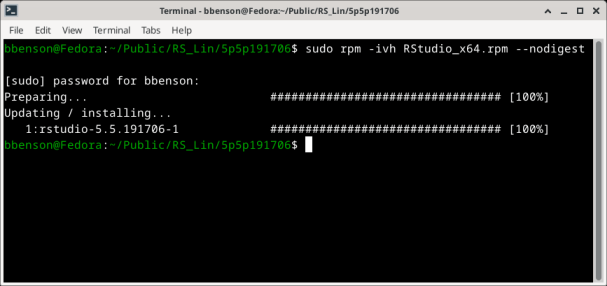
Click image to enlarge
You can begin using the program as soon as the installation is finished.
1. Once the software is installed, access our email with the registration key and its copy attached in a .txt file. Open the attachment, then select and copy the key. You can also copy the key directly from the message, but sometimes the mail server may corrupt it.
2. Click Show Apps and run R-Studio.
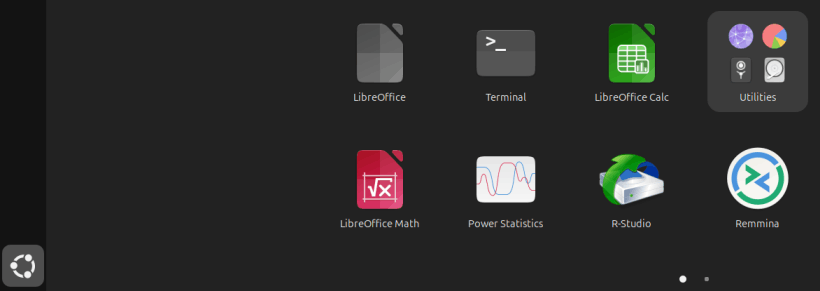
Click image to enlarge
The Please Register R-Studio for Linux Demo window will appear.
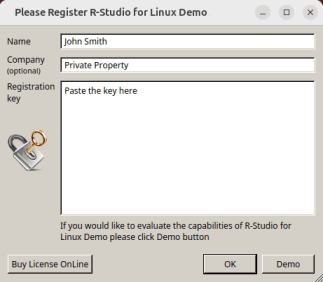
Click image to enlarge
You may register your copy of R-Studio if you already have a registration key, or continue in Demo mode if you want to estimate chances for successful data recovery. You may register your Demo version later on-the-fly without restarting the program.
Please note that R-Studio software does not transmit your data to R-TT, except for the information outlined in our R-TT privacy policy.
3. If the license is not activated, the License Agreement window will appear.
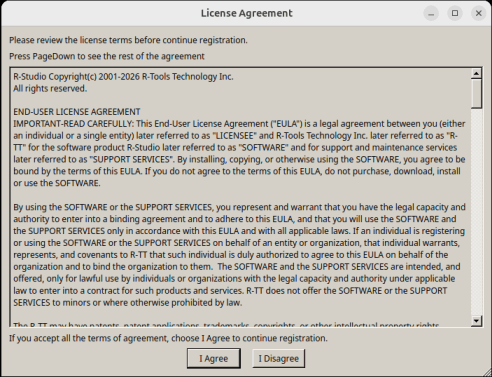
Click image to enlarge
4. Review the License Agreement and accept its terms and conditions, as you cannot continue without doing so.
Then the registration window will appear at startup.
If the software is running in Demo mode or needs re-registration, access the registration window through the Help > Register menu.
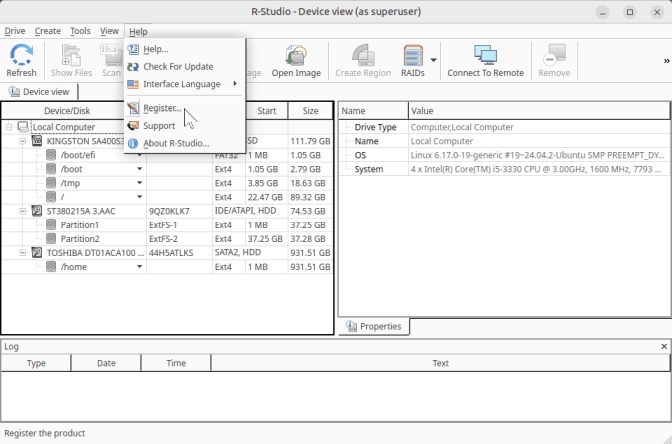
Click image to enlarge
5. Enter your registration information and paste the registration key. Do not type it in manually.
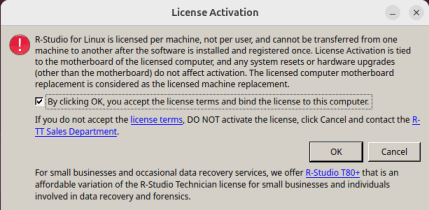
6. Click the OK button. The License Activation window will appear.
Click image to enlarge
7. Select the checkbox and click the OK button.
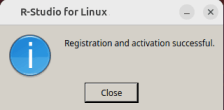
If the computer you wish to license is connected to the internet, it will be activated automatically, and a "Registration successful" window will appear.
Click image to enlarge
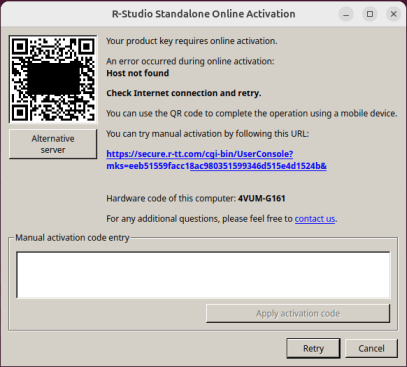
If the computer to be licensed is offline, the "Online Activation dialog box" will appear.
Click image to enlarge
You can either copy and use the provided URL on another device connected to the Internet, or scan the QR code with a smartphone to get the activation code and enter it to complete the activation.
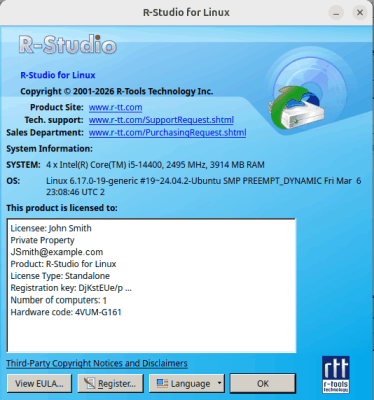
8. You can verify whether the activation was successful and see which license is tied to the hardware code of the licensed computer in the software's "About" window (Help>About).
Click image to enlarge
9. The R-Studio Emergency license is included with R-Studio Standalone and Corporate licenses. To learn how to create an R-Studio Emergency Startup Device and activate it, please review our article "Emergency File Recovery".
10. The R-Studio Agent and R-Studio Agent Emergency licenses are part of the R-Studio Corporate license. Detailed instructions for their use and activation can be found on our pages "Data Recovery over Network" and "Emergency Data Recovery over Network". The registration key for the R-Studio Corporate license is universal and also works with the Agent and Agent Emergency.
Uninstallation (the Debian package)
The software can be uninstalled from a Linux system computer by following these steps: Run Terminal and enter the following command:
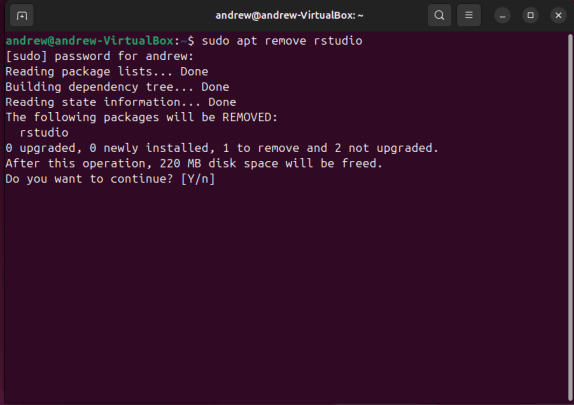
Click image to enlarge
Press Enter on the keyboard, and R-Studio will be uninstalled.
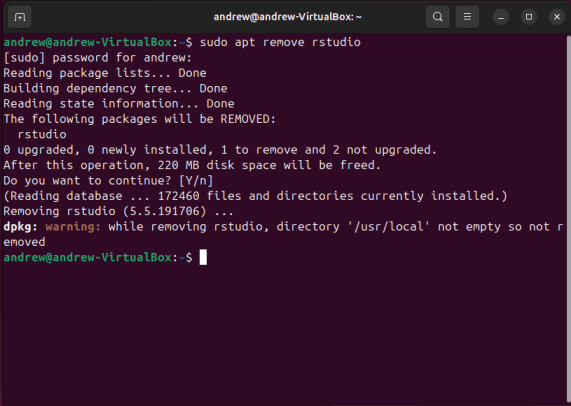
Click image to enlarge
Unstallation (with the FIPS mode on – the rpm package) Open Terminal and type "sudo rpm –e rstudio".
- R-Studio Technician: activation using a USB stick
- Data Recovery Guide
- Why R-Studio?
- R-Studio for Forensic and Data Recovery Business
- R-STUDIO Review on TopTenReviews
- File Recovery Specifics for SSD devices
- How to recover data from NVMe devices
- Predicting Success of Common Data Recovery Cases
- Recovery of Overwritten Data
- Emergency File Recovery Using R-Studio Emergency
- RAID Recovery Presentation
- R-Studio: Data recovery from a non-functional computer
- File Recovery from a Computer that Won't Boot
- Clone Disks Before File Recovery
- HD Video Recovery from SD cards
- File Recovery from an Unbootable Mac Computer
- The best way to recover files from a Mac system disk
- Data Recovery from an Encrypted Linux Disk after a System Crash
- Data Recovery from Apple Disk Images (.DMG files)
- File Recovery after Re-installing Windows
- R-Studio: Data Recovery over Network
- How To Use R-Studio Corporate Package
- Data Recovery from a Re-Formatted NTFS Disk
- Data Recovery from an ReFS disk
- Data Recovery from a Re-Formatted exFAT/FAT Disk
- Data Recovery from an Erased HFS Disk
- Data Recovery from an Erased APFS Disk
- Data Recovery from a Re-Formatted Ext2/3/4FS Disk
- Data Recovery from an XFS Disk
- Data Recovery from a Simple NAS
- How to connect virtual RAID and LVM/LDM volumes to the operating system
- Specifics of File Recovery After a Quick Format
- Data Recovery After Partition Manager Crash
- File Recovery vs. File Repair
- Data Recovery from Virtual Machines
- How to Recover Files from a Remote Computer Using R-Studio Standalone License and Its Network Capabilities in Demo Mode
- How to Connect Disks to a Computer
- Emergency Data Recovery over Network
- Data Recovery over the Internet
- Creating a Custom Known File Type for R-Studio
- Finding RAID parameters
- Recovering Partitions on a Damaged Disk
- NAT and Firewall Traversal for Remote Data Recovery
- Data Recovery from an External Disk with a Damaged File System
- File Recovery Basics
- Default Parameters of Software Stripe Sets (RAID 0) in Mac OS X
- Data Recovery from Virtual Hard Disk (VHD/VHDX) Files
- Data Recovery from Various File Container Formats and Encrypted Disks
- Automatic RAID Parameter Detection
- IntelligentScan Data Recovery Technology
- Multi-pass imaging in R-Studio
- Runtime Imaging in R-Studio
- Linear Imaging vs Runtime Imaging vs Multi-Pass Imaging
- USB Stabilizer Tech for unstable USB devices
- Joint work of R-Studio and PC-3000 UDMA hardware
- Joint work of R-Studio and HDDSuperClone
- R-Studio T80+ - A Professional Data Recovery and Forensic Solution for Small Business and Individuals Just for 1 USD/day
- Backup Articles
- R-Drive Image Standalone and Corporate license transferring
- Fixing Windows update error 0x80070643 with R-Drive Image
- Backup with Confidence
- R-Drive Image as a free powerful partition manager
- Computer Recovery and System Restore
- Disk Cloning and Mass System Deployment
- Accessing Individual Files or Folders on a Backed Up Disk Image
- R-Drive Image startup / bootable version
- File Backup for Personal Computers and Laptops of Home and Self-Employed Users
- Creating a Data Consistent, Space Efficient Data Backup Plan for a Small Business Server
- How to Move the Already Installed Windows from an Old HDD to a New SSD Device and Create a Hybrid Data Storage System
- How to Move an Installed Windows to a Larger Disk
- How to Move a BitLocker-Encrypted System Disk to a New Storage Device
- How to backup and restore disks on Linux and Mac computers using R-Drive Image
- R-Drive Image and Virtual Machines
- Undelete Articles
- Get Deleted Files Back
- Free Recovery from SD and Memory cards
- R-Undelete: Video Recovery
- Recovery from an External Device with a Damaged File System
- File recovery from a non-functional computer
- Free File Recovery from an Android Phone Memory Card
- Free Photo and Video File Recovery Tutorial
- Easy file recovery in three steps